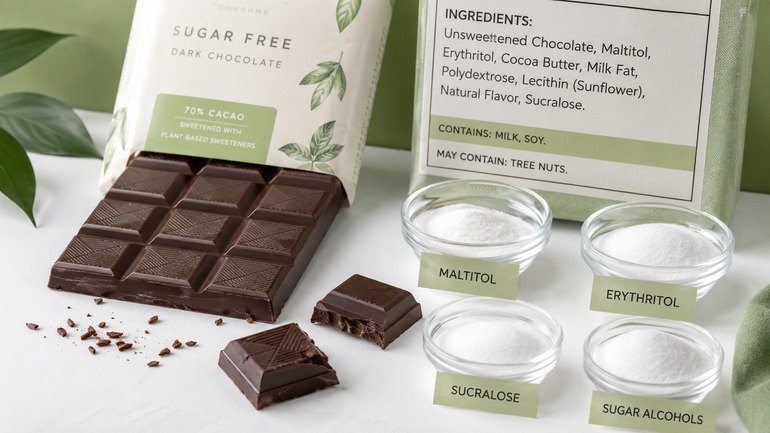
You pick up a sugar-free chocolate bar expecting a cleaner option. Then you turn the label around and find sweeteners, additives, and ingredients you may not recognize.
Sugar-free does not always mean better. Some replacements can cause digestive issues, while others have ongoing research around their long-term effects.
That does not mean every sugar-free chocolate bar is a bad choice. It means understanding what is replacing the sugar before you buy.
Maltitol
Maltitol is one of the most common sweeteners used in sugar-free chocolate because it creates a texture and sweetness that closely resembles regular sugar.
The problem is that the small intestine absorbs only part of maltitol. The remaining amount reaches the large intestine, where it can ferment and cause gas, bloating, or stomach discomfort.
Incomplete absorption is also why some sugar alcohols can have a laxative effect. The FDA requires foods containing sorbitol or mannitol to carry a warning that excess consumption may have a laxative effect. Most people tolerate small amounts. However, maltitol is found in many sugar-free candies and chocolates, so portions can add up quickly.
Sugar alcohols in general (Sorbitol, Mannitol, Xylitol)
Maltitol is not the only sugar alcohol used in sugar-free chocolate. Sorbitol, mannitol, and xylitol are also common alternatives.
These sweeteners can reduce sugar content, but they may cause digestive issues when consumed in larger amounts. Symptoms can include bloating, gas, cramps, and loose stools.
Digestive tolerance varies by sugar alcohol, dose, and individual. Some people can tolerate small amounts without symptoms, while larger servings may cause bloating, gas, cramps, or diarrhea.
Erythritol has become popular because it provides sweetness with fewer calories and usually causes fewer digestive problems than many other sugar alcohols.
Erythritol
However, recent research has raised questions about a possible connection between high blood erythritol levels and cardiovascular risk. A 2023 study published in Nature Medicine found an association between higher erythritol levels and increased risk of major cardiovascular events.
The study does not prove that consuming erythritol directly causes heart attacks or strokes. Researchers are still investigating whether the findings are related to dietary intake, the body’s natural production of erythritol, or underlying health factors.
A small 2024 intervention study involving 20 healthy volunteers also found that erythritol consumption sharply increased blood erythritol concentrations and measures of platelet activity. These findings add to the research questions around erythritol, but larger and longer-term studies are needed to determine their clinical significance.
Sucralose
Sucralose is a zero-calorie sweetener commonly used in sugar-free foods because it provides a strong sweetness without adding sugar or carbohydrates.
Some studies have raised questions about its possible effects on gut bacteria and metabolism. Research in animals found changes in gut microbiota and markers linked to inflammation after long-term exposure.
Human research remains mixed. One clinical study found possible changes in glucose and insulin responses after regular sucralose intake, but more research is needed to understand the long-term impact.
Other controlled research has found no significant short-term changes in gut bacteria or insulin sensitivity after sucralose consumption.
At this point, sucralose remains a debated ingredient rather than one with a clear health conclusion.
PGPR and Other Chocolate Emulsifiers
PGPR (polyglycerol polyricinoleate) is an emulsifier used in some chocolate products to improve texture and help manufacturers reduce the amount of cocoa butter needed.
PGPR itself is considered safe by food safety authorities when used within approved limits. PGPR is used to control viscosity and improve the flow of chocolate during manufacturing.
Its presence is not necessarily a health or quality concern on its own, but shoppers who prefer simpler formulations may choose products made primarily with cocoa mass, cocoa butter, sweetener, and minimal additional emulsifiers.
Some lower-cost chocolates use more additives, less cocoa butter, or cheaper ingredients to reduce production costs. These products may not provide the same cocoa experience as higher-quality chocolate.
Quick guide to ingredients in sugar-free chocolate
| Ingredient | Why It Is Used | What To Know |
| Maltitol | Creates sugar-like texture | May cause digestive discomfort |
| Sorbitol | Adds sweetness and moisture | Can cause bloating in larger amounts |
| Mannitol | Low-calorie sweetener | Stronger laxative effect |
| Xylitol | Sugar replacement | Usually tolerated but can affect digestion |
| Erythritol | Low-calorie sweetness | Cardiovascular research is still developing |
| Sucralose | Zero-calorie sweetness | Long-term effects remain debated |
| PGPR | Improves chocolate texture | May appear in lower-cost formulations |
What to look for instead?
Sugar-free chocolate can still be a good choice if you pay attention to the ingredient list. The goal is not avoiding every alternative sweetener but choosing products that fit your preferences and your body.
Look for chocolate with higher cocoa content, cocoa butter listed as a main ingredient, fewer unnecessary additives, and a sweetener you personally tolerate well.
A shorter ingredient list is usually a good sign. The best sugar-free chocolate is not simply the one without sugar. It is the one that replaces sugar thoughtfully.
The upshot
Sugar-free chocolate can be a useful option for reducing added sugar, but the label still matters. Ingredients like maltitol, other sugar alcohols, erythritol, sucralose, and certain additives each come with their own considerations.
The goal is not to avoid every sugar substitute, but to understand what you are eating and choose products that match your health goals and tolerance. A shorter ingredient list, higher cocoa content, and fewer unnecessary additives are usually signs of a better choice.
In the end, sugar-free does not automatically mean healthier. The best chocolate is the one that fits your diet, tastes good, and works well for your body.
Disclaimer
This article is for general informational purposes only and is not medical advice. If you have existing health conditions or concerns about sweeteners, consult a qualified healthcare professional before making major dietary changes.